
Athens Real Estate Market in 2026:
From Rapid Growth to Selective Investment
The Athens property market remains on an upward trajectory in 2026, but the nature of that growth has changed significantly. The period when almost any apartment purchase in the Greek capital could generate rapid capital appreciation is gradually giving way to a more mature, competitive, and highly location sensitive market.
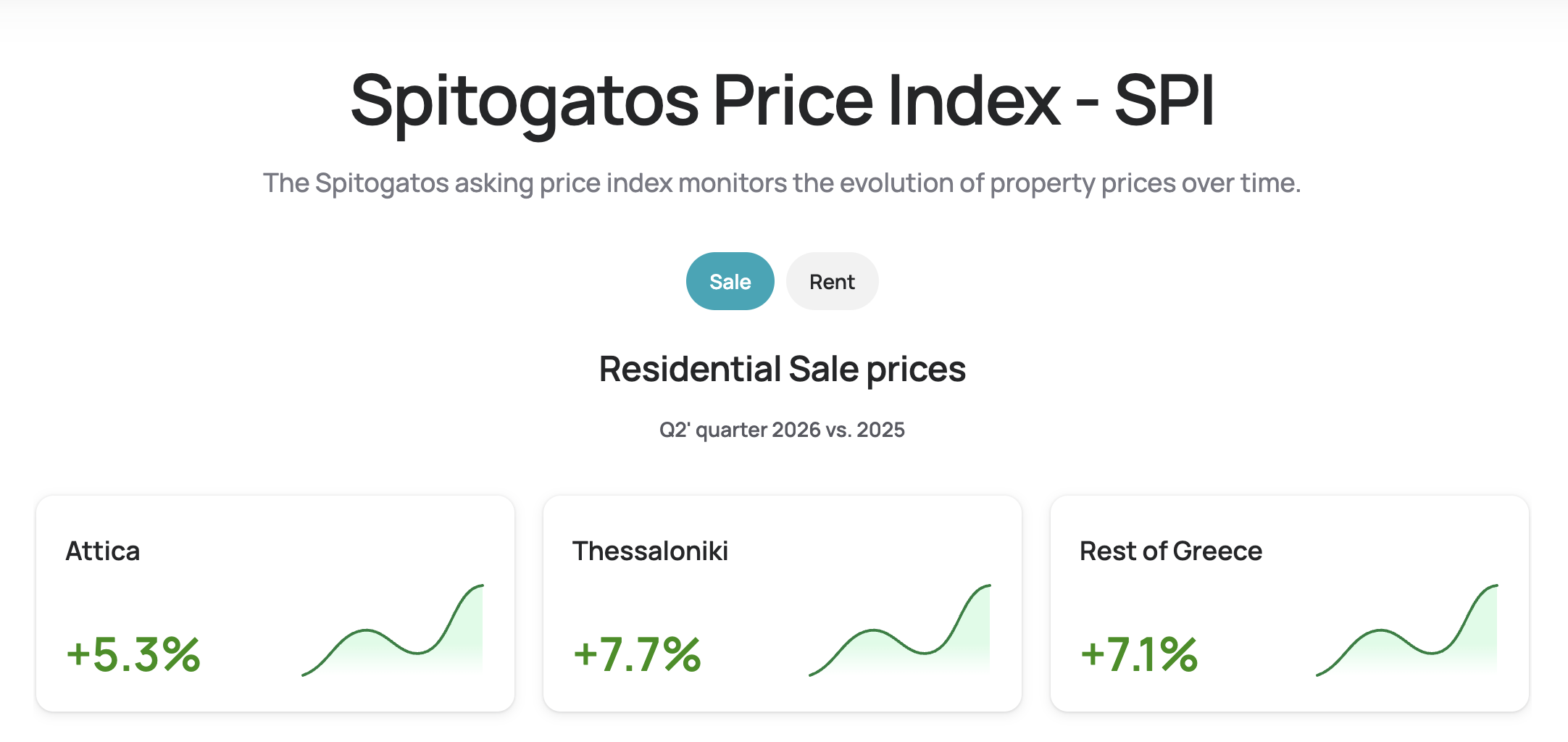
The latest Spitogatos.gr Property Index data for the second quarter of 2026 shows that asking prices for residential properties in Attica increased by 5.3% year on year. By comparison, annual growth stood at approximately 9.4% in the second quarter of 2025. The market is therefore still expanding, but the pace of price growth has clearly moderated.
At the same time, asking rents in Attica rose by 4.5%, broadly in line with the 4.4% increase recorded a year earlier.
For investors, the message is clear: Athens is not entering a downturn. Instead, it is moving from a phase of rapid, broad based appreciation into a more selective market, where asset quality, location, renovation costs, energy efficiency, and rental performance matter more than ever.

Athens Is Still Growing, but at a More Sustainable Pace
According to the Bank of Greece, apartment prices in Athens increased by 5.2% year on year in the first quarter of 2026. This compares with average annual growth of approximately 6.2% during 2025.
The difference between Bank of Greece figures and the Spitogatos.gr index is largely methodological. The Bank of Greece reflects transaction related data and bank valuations, while Spitogatos.gr tracks the asking prices published in property listings.
Despite these differences, both sources point to the same conclusion: prices are still rising, but at a slower rate than in previous years.
This moderation should not automatically be interpreted as weakness. For a long term investor, annual capital growth of around 5%, combined with rental income, may be more attractive than double digit but potentially unsustainable price increases.
A calmer market also creates more room for negotiation, detailed due diligence, and a clearer distinction between high quality assets and overpriced properties.
Understanding the Difference Between Asking and Transaction Prices
International investors should pay close attention to one important feature of the Spitogatos.gr index: it measures asking prices, not necessarily the final prices agreed in completed transactions.
In a market where growth is slowing, the gap between asking prices and actual sale prices may widen for certain properties, particularly those that:
● require major renovation
● have poor energy performance
● suffer from weak natural light, an undesirable floor, or limited accessibility
● are priced similarly to fully renovated properties
● have remained on the market for an extended period
Average price per square metre figures should therefore be treated as a starting point rather than a final valuation.
The true value of a property depends on its physical condition, legal status, renovation budget, neighbourhood quality, and rental potential.
Southern Athens: The Most Expensive and Defensive Market
Southern Athens remains the most expensive residential market in the capital and one of the costliest areas in Greece.
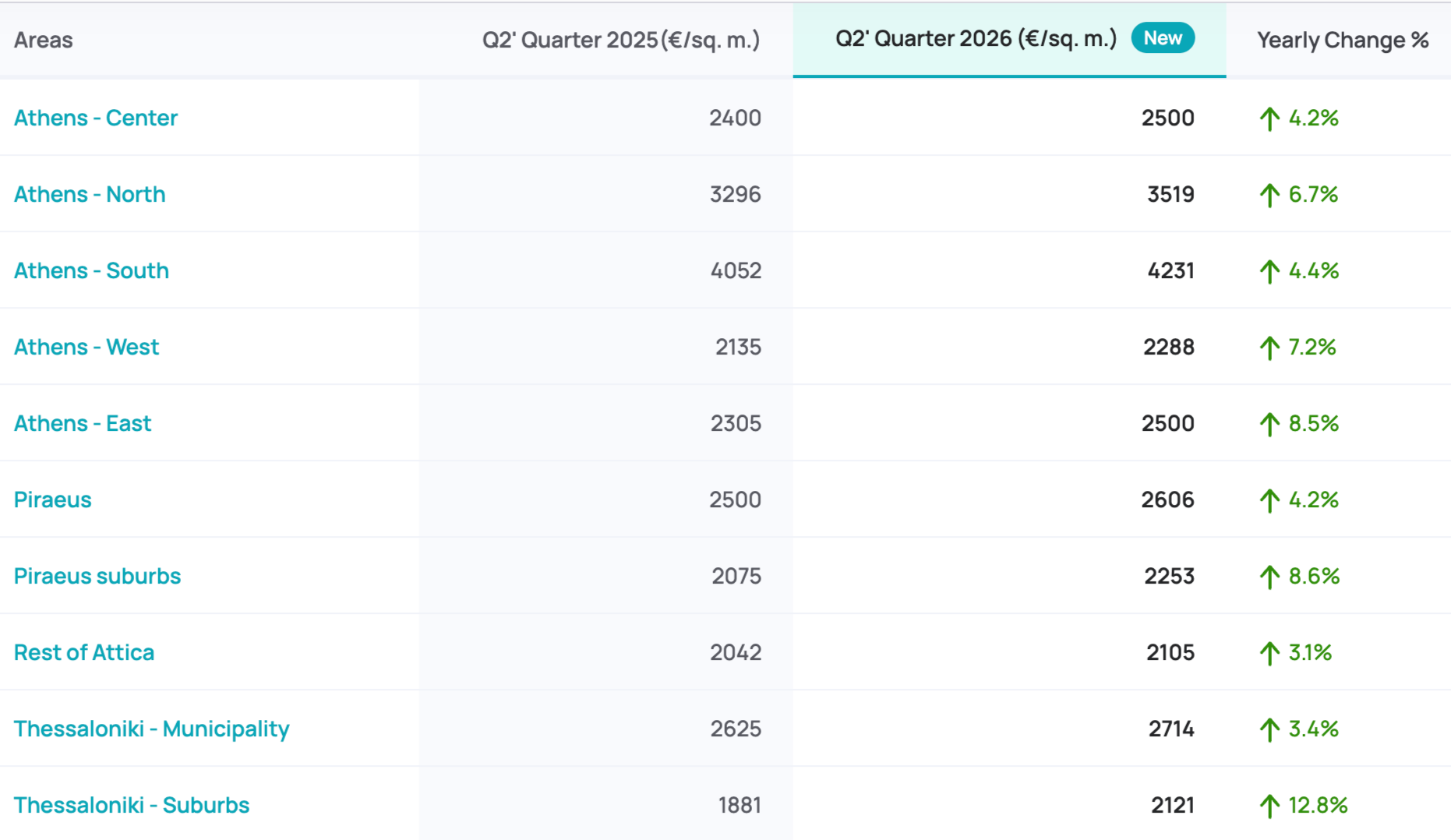
In the second quarter of 2026, the average asking price in Southern Athens reached approximately €4,231 per square metre.
Within the region, Vouliagmeni continued to lead the premium market, with average asking prices of around €7,364 per square metre.
These price levels confirm that the Athens Riviera can no longer be described as an inexpensive recovery market. Areas such as Vouliagmeni, Glyfada, Voula, and Elliniko are increasingly positioned alongside other premium Mediterranean residential destinations.
The investment appeal of Southern Athens is supported by four main factors:
● restricted land availability near the coast
● demand from international buyers and affluent Greek households
● the Ellinikon redevelopment and related infrastructure investment
● the ability of scarce, high quality properties to preserve capital over the long term
However, high acquisition prices mean that gross rental yields are often lower than in central or western districts.
Southern Athens is therefore generally more suitable for investors focused on capital preservation, international liquidity, and long term appreciation rather than maximum rental cash flow.
Does Southern Athens Still Have Growth Potential?
The answer is yes, but future performance is unlikely to be uniform.
New build properties, sea view apartments, energy efficient homes, and assets close to the Ellinikon development may continue to outperform.
By contrast, older and otherwise ordinary properties that are priced at a substantial premium simply because they are located in Southern Athens may deliver weaker returns.
In 2026, an address in Glyfada or Voula alone is no longer enough to guarantee strong investment performance.
Distance from the coast, access to the tram or metro, construction quality, parking, outdoor space, and energy efficiency now play a much greater role in determining value.
Central Athens: Strong Rental Demand, but Higher Risk
Central Athens remains one of the most important investment markets for foreign buyers.
Access to public transport, universities, employment centres, retail areas, and tourist attractions continues to generate strong rental demand.
According to Spitogatos data, Central Athens remains among the most expensive areas in Greece for renting, with average asking rents of approximately €11.8 per square metre per month in the second quarter of 2026.
At this level, a 70-square-metre apartment would theoretically command around €826 per month. Actual rent, however, will depend on the neighbourhood, renovation quality, furnishings, floor level, lift access, and lease duration.
Central Athens should not be treated as a single market.
Neighbourhoods such as Kolonaki, Pangrati, Koukaki, Ampelokipi, Kypseli, Patissia, and Metaxourgeio differ significantly in tenant profile, pricing, building quality, and investment risk.
The Main Opportunity in Central Athens in 2026
One of the strongest strategies in central Athens remains the acquisition of older apartments with good layouts and clear renovation potential.
A large share of the city’s housing stock is ageing, and many properties require upgrades to electrical systems, plumbing, heating, windows, and energy performance.
Investors can still create value by purchasing below the price of renovated stock and carrying out a carefully managed refurbishment.
However, this strategy is only effective when renovation costs are estimated realistically.
Higher material prices, labour costs, permit expenses, and energy efficiency requirements can significantly reduce project margins.
Investors should therefore look beyond a simple comparison between the purchase price of an old apartment and the resale value of a renovated one.
Financing costs, taxes, legal fees, brokerage commissions, vacancy periods, and furnishing expenses must also be included in the investment model.
The Athens Rental Market Continues to Support Prices
One of the most important strengths of the Athens market in 2026 is continued pressure on the rental sector.
While annual asking price growth in Attica slowed from 9.4% to 5.3%, asking rents still increased by approximately 4.5%.
This suggests that rental market strength is not simply a consequence of rising sale prices.
A shortage of suitable housing, reduced affordability for local homebuyers, student demand, labour mobility, and the presence of international professionals continue to support rents.
For investors, a period in which rents continue to rise while property price growth moderates may gradually improve rental yields, provided the asset is carefully selected.
Returns should nevertheless be calculated on a net basis rather than using headline rent alone.
The following expenses should be deducted from annual rental income:
● tax on rental income
● annual property tax
● unpaid common area charges
● insurance and repairs
● vacancy periods
● property-management fees
● long term maintenance and equipment replacement
Short Term or Long Term Rental?
In 2026, relying entirely on short term rental income in Central Athens involves greater regulatory risk than in previous years.
Greece has increased oversight of short term accommodation, while restrictions on new registrations have affected certain central districts. Standards relating to natural light, ventilation, safety, and lawful residential use have also become more important.
Investors should therefore avoid valuing a property solely on the basis of potential tourism platform income.
A more conservative base case should rely on long term or medium term rental performance, with short term letting treated as an alternative scenario.
Furnished apartments designed for corporate tenants, postgraduate students, visiting academics, international professionals, or stays of several months may offer a better balance between income and regulatory exposure.
Northern Athens: A Family Oriented Market for Higher Quality Assets
Northern Athens typically attracts affluent families, corporate executives, international employees, and buyers who prioritise quality of life, green space, schools, and larger homes.
Rental yields are not always among the highest in the city, but tenant stability and asset quality can be stronger.
In 2026, newly built and energy efficient homes in Northern Athens continue to attract demand because buyers and tenants in this segment tend to be more sensitive to construction quality and operating costs.
One notable development in the second quarter data was a 30.2% annual increase in average asking prices in Drosia.
However, this figure should not be interpreted as a uniform rise in the value of all properties in the area.
Spitogatos indicated that a higher proportion of villas, maisonettes, and energy efficient properties in the available listing stock had pushed up the average price.
This example highlights the importance of analysing the composition of listings. A sharp increase in a neighbourhood’s average price may sometimes reflect a change in the type of properties being advertised rather than a broad increase in values.
Western Athens and Piraeus: Potentially Higher Yield Opportunities
Investors with more limited budgets or a stronger focus on rental income often consider Western Athens and Piraeus.
These areas generally offer lower entry prices than Southern or Northern Athens, and some neighbourhoods may provide higher rental yields.
Transport infrastructure, port related employment, student demand, and gradual urban regeneration support the investment case.
However, conditions can vary substantially from one street or block to another.
Local inspections, safety assessments, transport access, the condition of neighbouring buildings, and the social profile of the area are particularly important in these markets.
Buying a property simply because it has a low price per square metre can be misleading.
A cheap asset in an area with weak demand, poor liquidity, or high maintenance costs may ultimately underperform a more expensive but better located property.
Limited Supply Continues to Support the Market
One of the strongest structural drivers of the Athens property market remains the limited supply of good quality housing.
Although new construction has increased, new supply in many districts is still insufficient to meet accumulated demand.
A large share of the city’s residential stock is several decades old, and many buildings no longer meet modern expectations in terms of parking, insulation, heating, cooling, lifts, and energy consumption.
As a result, the market is increasingly divided into two categories:
1. new or fully renovated properties sold at a premium;
2. older properties that require either a meaningful discount or a realistic renovation plan.
This gap has widened in 2026 and is likely to become even more important as European energy standards become stricter.
The Ellinikon Project and Its Impact on the Athens Riviera
The Ellinikon redevelopment remains one of the most important long-term drivers of the Southern Athens market.
The large mixed-use project on the site of the former Athens airport includes residential developments, hotels, retail areas, public spaces, and major new infrastructure.
Its impact is not limited to properties located within the development itself.
Improved infrastructure, stronger international visibility, the arrival of global brands, and the creation of new employment may support values across surrounding districts.
However, investors should distinguish between future growth potential and prices that already reflect optimistic expectations.
A significant part of the project’s psychological impact is already visible in land and property values across Southern Athens.
Purchases near Ellinikon should therefore be based on the underlying quality of the asset and a long term investment horizon rather than marketing expectations alone.
The Golden Visa Market in 2026
Greece’s residency-by-investment programme remains an important source of international demand, but higher investment thresholds in high-demand areas have changed investor behaviour.
In much of Attica, acquiring a property solely for Golden Visa eligibility now requires considerably more capital than in the past.
This has encouraged some investors to consider:
● larger and higher-quality assets;
● legally compliant conversions from commercial to residential use;
● qualifying renovation projects;
● areas outside the highest-threshold zones;
● alternative investment structures.
Foreign buyers should ensure that Golden Visa eligibility is confirmed by an independent lawyer before paying a deposit.
A property’s market value alone does not guarantee that the transaction qualifies for residency.


Which Property Types Look Most Attractive in 2026?
Several asset categories may offer a favourable risk return profile in the current market.
Small and Mid-Sized Apartments Near Metro Stations
Properties of approximately 45 to 85 square metres in areas with good metro access usually benefit from a broad tenant base.
They appeal to single professionals, couples, students, and corporate employees, and they are often easier to resell than very large apartments.
Renovated and Energy-Efficient Homes
Buyers and tenants are increasingly sensitive to energy costs.
Double glazed windows, independent heating, heat pumps, insulation, and energy efficient equipment can improve both rental demand and resale value.
Older Properties with Value Add Potential
This strategy remains attractive, but only where the purchase discount is sufficient to cover renovation costs, financing expenses, and project risk.
Premium Assets on the Athens Riviera
These are more suitable for investors seeking long term wealth preservation.
Scarcity, construction quality, and location should take priority over size or neighbourhood branding alone.
Properties Suitable for Medium Term Rental
Fully furnished apartments designed for stays of one to twelve months can provide a useful middle ground between holiday rentals and traditional long term leases.
The Main Risks Facing the Athens Market in 2026
Athens remains attractive, but it is not without risk.
Reduced Local Affordability
Sale prices and rents have risen faster than household incomes for many local residents.
If this gap continues to widen, it may eventually limit rental growth in certain districts.
Overpricing
Some sellers continue to price properties based on the rapid gains of previous years.
As the market slows, these listings may remain unsold for longer periods.
Renovation Costs
Underestimating technical and construction expenses remains one of the main reasons investment returns fall below expectations.
Regulatory Change
Rules governing short term rentals, taxation, building permits, and Golden Visa eligibility may change.
An investment strategy should not assume that regulations will remain unchanged for several years.
Liquidity Risk
Very large apartments, basement units, high floor properties without lifts, and buildings with legal irregularities may face limited resale demand.
Significant Differences Between Neighbourhoods
Regional averages do not reveal the quality of a specific street or building.
Local market analysis and physical inspection remain essential.
Outlook for the Second Half of 2026
Based on data available through the second quarter, the most likely scenario for the remainder of 2026 is continued but moderate price growth.
Under a base case outlook:
● premium areas in Southern Athens should continue to benefit from international demand
● Central Athens should maintain strong rental demand but face greater regulatory sensitivity
● new build and energy efficient properties are likely to outperform older stock
● sellers of average quality properties may need to accept more serious negotiation
● rents in Attica may continue to rise, although tenant affordability will limit unlimited increases.
A sharp short term fall in prices does not appear to be the central market scenario based on current data.
At the same time, a return to broad double digit growth across Athens also appears unlikely.
Recommended Strategy for European and International Investors
Successful investment in Athens in 2026 should be based on cash flow, asset quality, and risk control rather than on expectations of price appreciation alone.
Before purchasing, investors should prepare at least three scenarios:
● a conservative case with limited price growth and several months of vacancy
● a base case based on long term rental and moderate appreciation
● an optimistic case involving successful renovation or stronger neighbourhood demand.
Future capital appreciation should be treated as an additional benefit, not as the only source of profit.
Legal title, outstanding debts, planning permits, unauthorised alterations, structural condition, energy certification, and rental regulations should all be reviewed before the transaction is completed.
Conclusion
The Athens real estate market remains one of the most compelling property markets in Southern Europe in 2026, but its opportunities have become more complex.
Asking prices in Attica rose by 5.3% year on year in the second quarter, while Bank of Greece data showed apartment prices in Athens increasing by 5.2% in the first quarter. At the same time, asking rents in Attica increased by approximately 4.5%.
These figures point to a market that is still expanding but gradually shifting from rapid appreciation to growth supported by stronger fundamentals.
Southern Athens remains attractive for capital preservation and premium real estate. Central Athens continues to offer opportunities in rental housing and renovation. Western districts and Piraeus may provide lower entry prices and potentially higher yields, but they require more detailed local analysis. Northern Athens remains relevant for investors seeking stability, higher quality housing, and family driven demand.
The most successful investors in Athens in 2026 will not necessarily be those who buy the cheapest property.
They will be those who acquire the right asset at a rational price, with clean legal documentation, manageable operating costs, and genuine rental demand.
In this new phase of the market, returns are increasingly driven by neighbourhood selection, property quality, and professional asset management rather than by broad citywide price growth alone.